Research Article | | Peer-Reviewed

Anticipatory Healthcare Analytics: Inferring Latent Disease Dynamics from Noisy Clinical Observations

Received: 24 March 2026     Accepted: 7 April 2026     Published: 28 April 2026
Views:       Downloads:
Abstract

Artificial intelligence (AI) in healthcare is predominantly built on observational data that provide incomplete, delayed, and noisy representations of underlying biological processes. Such limitations constrain current predictive models, which often remain reactive and fail to capture the intrinsic dynamics of disease evolution. In this study, we introduce a novel AI-driven framework based on latent-state reconstruction, designed to infer hidden disease trajectories from partial clinical and population-level observations and to generate dynamic, forward-looking risk estimates. The proposed approach departs fundamentally from traditional methods by explicitly modeling healthcare systems as partially observed complex adaptive systems. It reconstructs latent health states that evolve over time and gives rise to observable clinical measurements subject to stochastic variability. Drawing a conceptual parallel to quantum mechanics, where a system’s true state is described by a wave function that governs probabilistic observations, our framework treats the latent health state as the primary object of inference rather than the observed data alone. This shift enables a transition from descriptive analytics to anticipatory intelligence. By deriving hazard functions from reconstructed latent trajectories, the framework provides earlier and more accurate detection of disease progression, outbreak dynamics, and systemic instability. Empirical and theoretical analysis demonstrates that this approach captures underlying population heterogeneity and temporal dynamics that are inaccessible to conventional models. This work establishes a new paradigm for AI in healthcare, where prediction is grounded in the reconstruction of hidden system dynamics, enabling proactive intervention and more reliable decision-making in complex, high-dimensional environments.

Published in Journal of Family Medicine and Health Care (Volume 12, Issue 1)
DOI 10.11648/j.jfmhc.20261201.11
Page(s) 1-13
Creative Commons

This is an Open Access article, distributed under the terms of the Creative Commons Attribution 4.0 International License (http://creativecommons.org/licenses/by/4.0/), which permits unrestricted use, distribution and reproduction in any medium or format, provided the original work is properly cited.

Copyright

Copyright © The Author(s), 2026. Published by Science Publishing Group

Keywords

Latent-state Reconstruction, Artificial Intelligence in Healthcare, Predictive Analytics, Hazard Function, Complex Adaptive Systems, Disease Progression Modeling, Early Detection

1. Introduction
Modern health informatics and complex system analytics face a fundamental challenge: the most important processes governing system behavior are rarely observed directly. In healthcare, clinicians and researchers observe laboratory tests, clinical notes, diagnoses, and physiological measurements recorded in electronic health records (EHRs); however, these observations represent only partial and often noisy manifestations of deeper biological processes evolving within patients or populations. Similarly, in epidemiology, defense systems, and large-scale socio-technical networks, observable signals provide only indirect evidence of the underlying mechanisms driving system dynamics.
This gap between observable data and the true system state motivates the development of new analytical frameworks capable of reconstructing hidden processes from incomplete information. Recent advances in clinical analytics have introduced new approaches to address this challenge through latent-state modeling, in which observable data are interpreted as projections of an underlying hidden state that evolves over time . Two such frameworks are Stochastic Artificial Intelligence Hazard Analysis (SAIHA) and Latent Adaptive Transformative Artificial Intelligence (LAT-AI), developed by de Melo . Stochastic health analytics focuses on reconstructing latent health trajectories from noisy observational data and transforming them into time-dependent hazard functions that quantify dynamic risk and enable early detection of disease progression and system instability.
Latent AI extends this idea by modeling complex adaptive systems (CAS) evolving latent processes whose trajectories can be inferred and monitored to support anticipatory decision making .
Interestingly, the conceptual foundation of these frameworks bears a strong resemblance to principles found in quantum mechanics. In quantum theory, the physical state of a system is described by a wave function that cannot be directly observed but governs the probabilistic outcomes of measurements. The evolution of this hidden state is described by the Schrödinger equation. Latent states can be analyzed by autoencoders whhich are a useful tool for probing latent states, especially for dimensionality reduction and feature discovery, but they are not a complete or neutral explanation of those states . A review of autoencoders with information theoretic concepts was published by Yu and Principe . Kingma discussed variational autoencoders .
In variational autoencoders (VAEs), learning is governed by a trade-off between reconstruction fidelity and latent regularization, formalized through the evidence lower bound (ELBO). The reconstruction term encourages the latent variable z to preserve sufficient information about the input x to enable accurate decoding, effectively promoting high-fidelity latent reconstruction. In contrast, the Kullback–Leibler (KL) divergence term constrains the approximate posterior q(z∣x) to remain close to a predefined prior, typically an isotropic Gaussian, thereby limiting the information capacity of the latent space and enforcing global structure . This interplay can be interpreted as an information bottleneck: the model must compress input data into a structured latent representation that balances informativeness against simplicity. Adjusting the relative weight of the KL term, as in β-VAE, makes this trade-off explicit, with higher values encouraging more disentangled but less detailed reconstructions, and lower values favoring reconstruction accuracy at the expense of latent organization . Consequently, the quality of latent reconstruction in VAEs is not solely determined by reconstruction loss, but by how effectively the model allocates information under the regularization imposed by the KL divergence .
Latent recovery was used in survival analysis. Schober and Vetter interpreted survival analysis aa interpretation of time-to-event data . Pang et al. used time series to predict hazards . Arcuri et al. compared hazard prediction with Cox hazard modeling . De Melo et al. developed a stochastic continuation of deterministic Weibull solution . A relation of latent reconstruction to machine learning was demonstrated by Silva et al. . Williams considered an optimized statistical-gradient algorithm for reinforcement learning . An interesting work has been done by Gao et al. for generation of latent state using zero-show learning . In this paper, we discuss a new algorithm that enables the reconstruction of latent health states that evolve over time and gives rise to observable clinical measurements subject to stochastic variability.
2. State-Space Representation
Both quantum mechanics and latent-state AI frameworks describe systems using state vectors evolving in time. In quantum mechanics the system states the wave function:
iψx,tt=Ĥψx,t,(1)
where ψ(x,t) is system state (wave function), Ĥ = Hamiltonian operator describing system dynamics.
The wave function represents a hidden state that cannot be directly observed. In health latent analytics (HLA) a similar concept exists:
1) xt represents a latent system state
2) Observations are noisy measurements derived from that state.
The evolution of this latent state is written as:
dxtdt=fxt,ut,θ,(2)
The term u(t) represents external influences acting on the system over time. These are variables that affect the latent state but are not part of the state itself. They may vary with time and often correspond to interventions, environmental conditions, or control signals. In healthcare analytics, examples include medical treatment administered to a patient, dosage of medication over time, lifestyle changes such as diet or exercise, environmental exposures such as pollution, vaccination campaigns in population health Parameter θ is learned from data, such as weights in neural networks, coefficients in regression models, transition parameters in state-space models, hazard coefficients in survival models. These parameters are estimated by fitting the model to observed data.
Thus, both frameworks rely on state-space dynamical systems. In quantum mechanics, observable probabilities are derived from the wave function.
Px,t=ψx,t2(3)
This equation converts the hidden state into observable probability distributions. Similarly, in health analytics the latent state x(t) is transformed into a hazard function representing risk:
λt=λ0eβxt
Here the latent state xt determines the instantaneous risk of an event. Thus, both frameworks map hidden states to observable probabilities. For a single particle in a potential field V(x),
iψ(x,t)t=-22m2x2+V(x)ψ(x,t)(4)
This has two main parts:
Ĥ=diffusion curvature term+potential term
The second derivative term measures how the hidden state bends across space. That same kind of curvature term appears in stochastic latent-state models. This can be seen in equation (5) that represents the Fokker–Planck equation:
p(x,t)t=122x2 [g2(x,t)p(x,t)] -x [f(x,t)p(x,t)](5)
If we replace real time t by imaginary time:
τ=it
then the Schrödinger equation transforms into a diffusion equation:
ψ(x,τ)τ=22m2x2-V(x)ψ(x,τ)(6)
or equivalently
ψτ=D2ψx2-U(x)ψ
where
D=22m
is a diffusion coefficient. This is interesting because latent-state inference behaves mathematically the same way as the diffusion of uncertainty through hidden state space. Here p(x,t) is the probability density of the latent state, f(x,t) is the drift term, and g(x,t) is the stochastic noise amplitude. This is highly relevant to stochastic modeling in healthcare, because it says that the hidden state is not just a single number. It is a distribution that moves in time under two forces:
1) drift, which reflects systematic change such as disease progression or recovery in healthcare,
2) diffusion, which reflects uncertainty, noise, variability, and hidden perturbations
That is exactly how one would describe evolving latent health states. Sources of stochastic noise in healthcare include:
1) measurement errors in clinical data
2) biological variability between patients
3) unknown environmental factors
4) unrecorded clinical interventions
5) stochastic biological processes
If g(x,t)is large, the latent state becomes highly unpredictable.
If g(x,t)is small, the system behaves almost deterministically. Suppose the latent health state follows
dxt=(αxt-βut)dt+σdWt
where
1) αxt describes natural disease progression
2) βut describes treatment effect
3) σdWt represents biological randomness
Here
1) drift = f(x,t)=αxt-βut
2) noise amplitude = g(x,t)=σ
3. Latent-state Dynamics
A latent health state can be modeled as a stochastic differential equation.
dxt=f(xt,ut,θ)dt+g(xt)dWt
where xt is the hidden health state, ut is intervention or external input, θ are system parameters, dWt is Brownian noise.
This is where your framework becomes especially original.
Suppose the latent health state has density p(x,t). Then hazard can be defined as a functional of that latent distribution:
λ(t)=h(x)p(x,t)dx
where h(x) is a risk-generating function. This is mathematically important because hazard is no longer tied to raw observations alone. It emerges from the distribution of hidden states. For example, if deteriorating latent health increases event risk exponentially, then
h(x)=λ0eβx
and the hazard becomes
λ(t)=λ0eβxp(x,t)dx
In quantum mechanics, the map is:
ψ(x,t)p(x,t)observable measurements
and in health analytics:
xtp(x,t)clinical observations and hazard
In AI, latent-state estimation often minimizes a loss such as
L=tyt-ŷt2+αtxt-f(xt-1)2+βΩ(x)
This has the same flavor:
1) fit the observations
2) enforce smooth hidden dynamics
3) penalize implausible latent trajectories
So, both fields search for the most plausible hidden evolution by optimizing a functional.
Compact bridge from Schrödinger to SAIHA/LAT-AI is this chain:
Hidden state dynamics →probability density evolution→measurement process→risk/hazard estimation
In quantum mechanics:
ψ(x,t)ψ(x,t)2measurement probabilities
In SAIHA/LAT-AI:
dxt=f(xt,ut,θ)dt+g(xt)dWtp(x,t)yt=M(xt)+ϵtλ(t)=h(x)p(x,t)dx
That is the mathematically interesting bridge.
The deepest common mathematics is this: both frameworks study an unobservable evolving state, and both use equations that describe how the state or its probability distribution changes in time under structure plus uncertainty. Quantum mechanics expresses this through the Schrödinger equation; SAIHA and LAT-AI express it through stochastic state equations, filtering, and hazard functionals over latent-state densities.
That is why Schrödinger-style thinking is not merely a metaphor for SAIHA/LAT-AI. It suggests a real mathematical language for describing hidden clinical dynamics, uncertainty propagation, and anticipatory risk estimation. In the special theory of relativity introduced by Albert Einstein, the time experienced by a moving object, called proper time, differs from the time measured by a stationary observer. Proper time is determined by integrating a velocity-dependent factor along the object's trajectory in spacetime. For an object moving with velocity vt, proper time is expressed as:
τ=1-v(t)2c2dt(7)
where c denotes the speed of light. This expression indicates that time accumulation depends on the path taken through spacetime. The integral represents the length of the object's worldline in Minkowski spacetime. A comparable structure appears in survival analysis. The survival function can be written in terms of the cumulative hazard function:
St=exp-0tλudu(8)
where λt denotes the hazard rate at time t. If we take the logarithm of (2), we obtain:
logSt=-0tλudu
or equivalently:
-logSt=0tλudu
The right-hand side is the cumulative hazard:
Ht=0tλudu(9)
H(t) in (3) is:
Ht=-logSt
Both equations (1) and (3) describe a quantity obtained by integrating a time-modifying function along a trajectory. The relativity theory focuses on:
τt=0tgudu
with
gu=1-v(u)2c2
Survival analysis (3) represents cumulative hazard, which measures the accumulated exposure to risk over time. Survival probability is then determined by the exponential decay associated with this accumulated risk. These two expressions share a similar mathematical form. In relation to the object, time experienced by an object is obtained by integrating a function that modifies time according to velocity. In survival analysis, the progression toward an event is determined by integrating a function that modifies time according to risk intensity. In both cases, the observable outcome depends on the accumulation of a modifying factor along a trajectory.
From this perspective, survival analysis can be interpreted as operating within a transformed time coordinate. Calendar time t may be mapped to a risk-adjusted time scale defined by the cumulative hazard.
τst=0tλudu
Under this transformation, survival probability becomes:
St=e-τst(10)
which indicates that survival follows an exponential decay in the transformed time coordinate. The Kaplan–Meier estimator approximates this process discretely by multiplying conditional survival probabilities across successive event times.
Within this framework, the progression of disease can be interpreted as movement through a risk landscape in which the cumulative hazard corresponds to the accumulated exposure along the patient's trajectory. This interpretation parallels the concept of a worldline in relativity, where the experienced time of a system depends on its path through spacetime.
Extensions of this idea appear in advanced survival modeling frameworks that incorporate latent physiological states and stochastic dynamics. In the Stochastic Augmented Integrated Hazard Analysis framework, latent processes influencing patient health are reconstructed through stochastic augmentation, allowing the hazard function to evolve according to hidden physiological trajectories. This approach enables more accurate prediction of survival outcomes because it accounts for the dynamic and partially unobserved nature of clinical systems.
Viewing survival analysis through a geometric perspective highlight how patient outcomes depend on trajectories through risk space rather than simply on elapsed calendar time. This perspective connects concepts from physics, probability theory, and health informatics, and may provide new directions for modeling time-dependent biomedical processes, particularly in the context of artificial intelligence and dynamic clinical decision support systems.
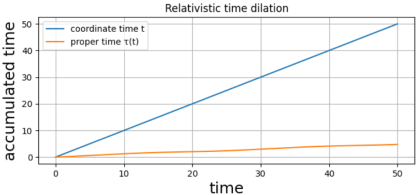
Figure 1. Comparison of coordinate time and relativistic proper time.
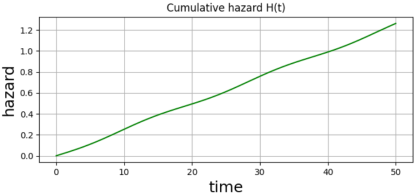
Figure 1 represents the coordinate time t (blue line) measured by a stationary observer, which increases linearly. The orange curve shows the accumulated proper time, which grows more slowly due to relativistic effects at high velocity. This divergence demonstrates how time passes at different rates depending on the relative motion between observers, a key prediction of special relativity. The increasing gap between the two curves highlights the cumulative nature of time dilation over longer durations.
Figure 2. Cumulative hazard function Ht.
Figure 2 depicts the cumulative hazard represents the accumulated risk over time and is defined as Ht=0tλudu, where λt the hazard rate is. The curve increases monotonically, reflecting the progressive accumulation of risk in survival analysis.
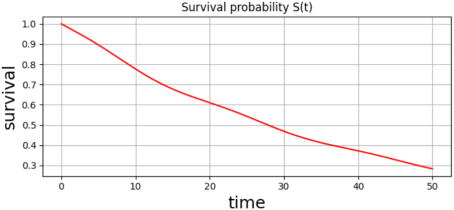
Figure 3. Survival probability St.
Figure 3 shows the survival function, the probability that an individual survives beyond time t. It is defined as St=exp-Ht, where Htis the cumulative hazard. As cumulative hazard increases over time, the survival probability decreases, illustrating the relationship between risk accumulation and survival outcomes in time-to-event analysis.
3.1. Weibull Hazard Function in Survival Analysis
The Weibull model is one of the most widely used parametric models in survival analysis and reliability theory. It provides a flexible framework for describing how the instantaneous risk of an event evolves over time. The model is particularly valuable in healthcare analytics because it can represent increasing, decreasing, or constant hazard patterns depending on the value of its shape parameter. This flexibility makes the Weibull distribution suitable for modeling a wide range of clinical outcomes, including patient survival, disease progression, equipment failure in medical devices, and time to readmission.
The Weibull distribution is characterized by two parameters: a scale parameter α>0 and a shape parameter β>0. The hazard function for the Weibull model is defined as:
λt=αβtβ-1
where t denotes time. The hazard function describes the instantaneous rate at which events occur among individuals who have survived up to time t. The behavior of the hazard function depends strongly on the value of the shape parameter β.
When β>1, the hazard increases over time. This situation is common in many chronic diseases in which the risk of an adverse outcome grows as the disease progresses or as patients age. For example, the risk of mortality in progressive cancers or degenerative conditions often follows an increasing hazard pattern.
When β=1, the hazard becomes constant over time:
λt=α
In this case, the Weibull model reduces to the exponential survival model. A constant hazard implies that the probability of the event occurring in the next instant does not depend on how long the individual has already survived.
When β<1, the hazard decreases over time. This pattern is frequently observed in clinical situations where the initial risk is high but decreases as time passes. Examples include postoperative mortality risk or complications following acute medical interventions. Patients who survive the early high-risk period often experience a substantially lower risk later.
The cumulative hazard function associated with the Weibull model is obtained by integrating the hazard function over time:
Ht=0tλudu=αtβ
The survival function, which represents the probability that an individual survives beyond time t, is then given by
St=exp-Ht=exp-αtβ
This representation highlights the relationship between survival probability and cumulative hazard. As cumulative hazard increases, survival probability decreases exponentially.
One important advantage of the Weibull model is that it directly links the hazard function and survival function through simple analytic expressions. This property allows researchers to interpret how changes in model parameters influence both the rate of risk accumulation and the shape of the survival curve.
In healthcare analytics, the Weibull model is widely applied in studies of patient survival, disease recurrence, and treatment effectiveness. Because it provides explicit expressions for hazard and survival functions, it also serves as a useful framework for simulation and predictive modeling. From a conceptual standpoint, the Weibull survival function can be interpreted as operating on a transformed time scale. Specifically, the expression:
-logSt=αtβ
shows that the cumulative hazard acts as a transformed measure of time that incorporates the evolving risk structure of the system. This interpretation connects naturally with the broader framework of survival analysis, where patient outcomes depend not only on chronological time but also on the dynamic accumulation of risk factors.
The flexibility and interpretability of the Weibull hazard function make it an important component of modern survival modeling. Its ability to capture diverse patterns of risk over time allows researchers to describe complex time-to-event processes and to gain deeper insight into the temporal dynamics of disease and treatment outcomes.
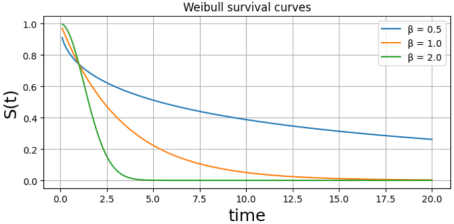
Figure 4. Weibull survival curves illustrating the effect of the shape parameter βon survival dynamics.
Figure 4 shows that decreasing hazard (β<1) produces a slowly declining survival curve, constant hazard (β=1) corresponds to the exponential survival model, and increasing hazard (β>1) leads to a rapid decline in survival probability.
The Weibull survival model can be interpreted as operating on a transformed time scale.
τWt=αtβ
which plays a role like proper time in relativity: it represents an effective internal time determined by the dynamics of the system. While relativity describes trajectories in spacetime, survival analysis describes trajectories through risk space.
Thus, the relationship between the Weibull model and relativity is conceptual and mathematical. Both frameworks illustrate how the effective progression of time can be altered by underlying processes and expressed through integrals that accumulate those effects over time.
3.2. Cox Proportional Hazards Model
The Cox proportional hazards model can also be interpreted within the same conceptual framework, although it arises directly from statistical theory rather than physics. The model was introduced by David R. Cox and is widely used in survival analysis because it allows the hazard rate to depend on multiple explanatory variables without specifying the exact baseline distribution of survival times.
In the Cox model, the hazard function is written as
λtx=λ0teβx
where λ0tis the baseline hazard function and x represents a vector of covariates such as age, treatment type, or biomarkers. The term eβx modifies the baseline hazard according to the characteristics of everyone.
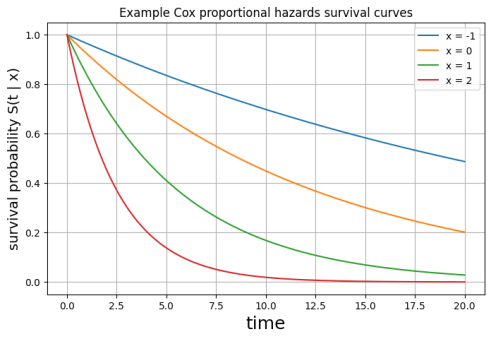
Figure 5 illustrates those higher values of x increase the hazard λtx=λ0teβx, resulting in faster decline of survival probability over time. The Cox proportional hazards model can also be interpreted within the same framework of accumulated processes that was previously discussed in connection with relativistic time dilation and Weibull survival models. In the Cox model, the hazard function is written as λtx=λ0teβx, where the exponential term modifies the baseline hazard according to individual covariates.
Figure 5. Cox proportional hazards survival curves.
The Cox model is written as
λtx=λ0teβ1x1+β2x2++βpxp
where
1) x1,x2,,xpare covariates (age, treatment, biomarkers, comorbidities, etc.)
2) β1,β2,,βpare estimated coefficients from the data
3) λ0tis the baseline hazard
The term
β1x1+β2x2++βpxp defines a point in a p-dimensional covariate space. Each patient can be represented as a vector:
x=x1,x2,,xpT
in a multidimensional risk space. For example,
Table 1. Definition of model variables used in the analysis, including demographic, clinical, treatment, and biomarker-related features.

Variable

Meaning

x1

Age,

x2

Blood pressure

x3

Treatment indicator

x4

Biomarker level

Then a patient corresponds to a point in a 4-dimensional risk space. Hazard as a surface in risk space. The hazard becomes
λtx=λ0teβx
where
βx is a dot product. Thus, the Cox model defines a risk surface over multidimensional covariate space.
Geometric interpretation: patients move through risk space over time. The accumulated risk becomes
Htx=eβxH0t
so, the covariate vector effectively scales the rate at which risk accumulates.
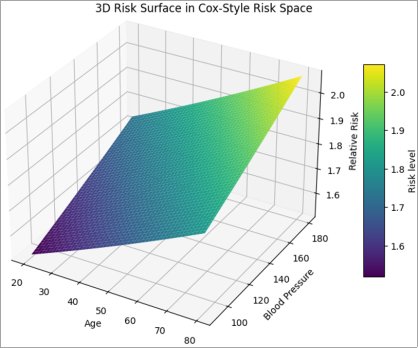
Figure 6. Three-dimensional risk surface in a Cox-style risk space defined by age and blood pressure, with glucose held constant.
The surface in Figure 6 represents relative risk estimated from a proportional hazards model, where increasing values of the covariates lead to higher estimated hazard. The color gradient indicates the magnitude of relative risk, illustrating how combinations of clinical variables determine the risk level within the multidimensional covariate space.
3.3. Stochastic Augmented Integrated Hazard Analysis (SAIHA)
Traditional survival models treat the hazard as either a deterministic function of time or a function of static covariates. However, clinical systems are inherently dynamic. Patient health evolves continuously through complex physiological processes that may not be fully observable in electronic health records. SAIHA addresses this limitation by introducing a latent state representation of patient health and allowing the hazard function to depend on this evolving state . Let xt denotes the latent physiological state vector describing the health status of a patient at time t. This state may include variables such as immune response, metabolic condition, or other hidden clinical factors that influence survival risk. The evolution of the latent state is modeled as a stochastic dynamic system:
dxt=fxt,tdt+ΣdWt,
where fx,t describes deterministic physiological dynamics and dWt represents stochastic fluctuations, and Σ is a covariance matrix controlling the magnitude of the stochastic perturbation. The hazard function is then defined as a mapping from the latent state to risk:
λt=gxt
where g is a function translating physiological state into instantaneous risk. The cumulative hazard becomes
Ht=0tλudu
and the survival probability is
St=exp-Ht.
Unlike traditional models where the hazard depends only on observed covariates, SAIHA allows the hazard to evolve according to the stochastic trajectory of the latent health state.
SAIHA generalizes several traditional survival frameworks. If the latent state is constant,
xt=x
then the model reduces to the Cox proportional hazards formulation
λtx=λ0teβx.
If the hazard is defined as a power function of time,
λt=αβtβ-1,
then the cumulative hazard becomes
Ht=αtβ
and the model reduces to the Weibull survival model.
Thus, SAIHA can be viewed as a dynamic extension of classical survival models. Conceptual connection with relativity. The mathematical structure of SAIHA parallels the relativistic concept of time accumulation. Thus, the survival process can be interpreted as the accumulation of risk along a trajectory in health-state space, just as proper time in relativity accumulates along a trajectory in spacetime. In the Stochastic Augmented Integrated Hazard Analysis (SAIHA) framework, the goal is essentially to recover or reconstruct the latent health-state space that governs the evolution of risk. This latent space represents underlying physiological processes that are not directly observed in clinical data but strongly influence survival outcomes.
In classical survival models such as Kaplan–Meier, Weibull, or the Cox proportional hazards model, the hazard function depends either on time alone or on a set of observed covariates. However, many important biological processes remain hidden. Electronic health records typically capture only partial and noisy measurements of the patient's true physiological condition. As a result, the observed variables represent only a projection of a deeper underlying system.
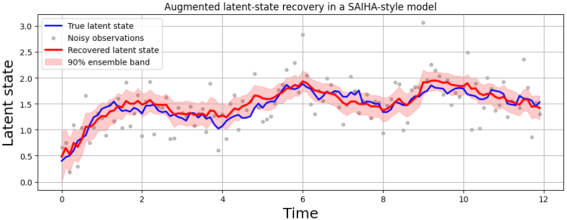
Figure 7 shows the true latent trajectory (blue) generates noisy observations (gray points). The recovered latent state (red) is estimated using stochastic augmentation with an ensemble representation of the latent dynamics. The shaded region represents the 90% ensemble uncertainty interval around the recovered trajectory.
In Figure 8, the blue curve shows the hazard computed from the true latent state, while the red curve shows the hazard derived from the recovered latent trajectory. The close agreement illustrates how accurate reconstruction of the latent state allows reliable estimation of time-dependent risk.
The blue curve represents survival computed from the true latent-state–derived hazard, while the red curve shows survival estimated using the hazard derived from the recovered latent trajectory. The close agreement between the two curves demonstrates that accurate reconstruction of the latent health state enables reliable estimation of survival dynamics.
Figure 7. Recovery of a latent physiological state using the stochastic augmented integrated hazard analysis (SAIHA) framework.
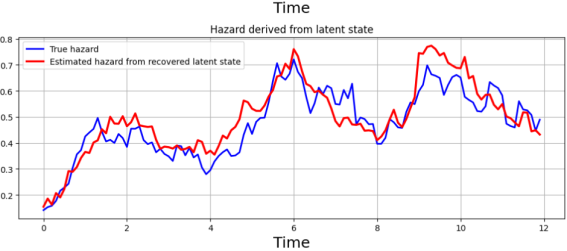
Figure 8. Hazard functions derived from the latent health state in a SAIHA framework.
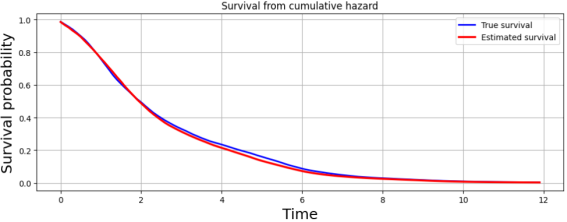
Figure 9. Survival probability derived from cumulative hazard in the SAIHA framework.

Figure 9 depicts survival probability as a function of time derived from the cumulative hazard function. The blue curve represents the true survival function, while the red curve shows the estimated survival obtained from the cumulative hazard. The close agreement between the two curves across the time range indicates that the estimation method accurately recovers the underlying survival pattern, with only minor deviations at intermediate times.
4. Discussion
The latent-state formulation provides a conceptual advantage over traditional survival approaches. Classical methods such as the Kaplan–Meier estimator describe survival purely as a function of observed event times, without incorporating dynamic physiological processes. Parametric models such as Weibull assume a predetermined functional form for the hazard, while semi-parametric approaches such as the Cox proportional hazards model link risk to fixed covariates measured at baseline or updated intermittently. In contrast, SAIHA treats risk as emerging from a continuously evolving latent state that integrates multiple biological influences. This perspective reflects the reality of clinical systems, where disease progression is governed by complex physiological interactions that are only partially captured by routine clinical measurements.
The simulation results demonstrate that stochastic augmentation can effectively reconstruct the latent trajectory despite substantial measurement noise. The ensemble-based recovery approach allows multiple plausible trajectories to be explored simultaneously, reducing sensitivity to observation errors and improving stability of the estimated latent state. Once the latent trajectory is reconstructed, the hazard function can be derived directly from this state, allowing the cumulative hazard and survival probability to be computed through standard survival equations. The close agreement between survival curves derived from the true latent state and those derived from the recovered trajectory confirms the validity of this approach.
An important implication of this framework is that survival outcomes can be viewed as the result of trajectories through a latent physiological state space. In this interpretation, patients follow paths through an evolving health-state landscape, and the hazard represents the instantaneous risk associated with their current position in that space. Survival probability then emerges from the accumulation of risk along the trajectory. This geometric perspective aligns naturally with modern approaches in dynamical systems and state-space modeling, where complex processes are described through hidden states and their temporal evolution.
The latent trajectory interpretation also creates an interesting conceptual connection with the theory of relativity. In relativity, the experienced proper time of an object depends on its trajectory through spacetime. Similarly, in SAIHA the accumulated risk depends on the trajectory of the patient through latent physiological state space. In both frameworks the observable outcome is obtained through integration along a path in an underlying state space. Although the two theories arise in entirely different scientific domains, this structural similarity highlights the general importance of trajectory-based accumulation processes in modeling complex dynamical systems.
The proposed framework also has important implications for health informatics and predictive medicine. Because the latent state integrates information from multiple measurements over time, it can provide a more stable and informative representation of patient condition than individual clinical variables. This may enable earlier detection of deteriorating health states and improved forecasting of adverse outcomes. Furthermore, the stochastic augmentation approach allows uncertainty in patient trajectories to be explicitly represented, which is particularly valuable when working with incomplete or noisy clinical data.
5. Conclusion
This work explored a conceptual and mathematical connection between relativistic time accumulation and survival analysis in healthcare and introduced the Stochastic Augmented Integrated Hazard Analysis (SAIHA) framework as a dynamic extension of classical survival modeling. Traditional survival methods such as the Kaplan–Meier estimator, the Weibull model, and the Cox proportional hazards model describe survival outcomes through the accumulation of hazard over time. However, these models typically rely on either time-dependent hazard functions or static covariates and do not explicitly account for hidden physiological processes that evolve dynamically.
SAIHA addresses this limitation by introducing a latent health state that governs the evolution of risk. The latent state represents an underlying physiological condition reflecting the combined effects of multiple biological processes that are only partially observed in clinical data. Using stochastic augmentation and ensemble-based estimation, the latent trajectory can be reconstructed from noisy observations such as clinical measurements and laboratory values. Once the latent state is recovered, the hazard function can be modeled as a function of this evolving state, and survival can be obtained through the cumulative hazard.
The framework demonstrates that survival outcomes can be interpreted as the result of risk accumulation along a trajectory in latent health space. This perspective closely parallels the relativistic concept introduced by Albert Einstein, where proper time accumulates along a trajectory in spacetime. In both cases, the observable quantity emerges from integrating a dynamic factor along a path through an underlying state space. In survival analysis, the cumulative hazard plays a role analogous to accumulated proper time, while the patient trajectory through latent physiological space determines how risk evolves.
The numerical examples presented illustrate how latent-state recovery enables accurate reconstruction of hazard and survival dynamics even when the underlying physiological process is not directly observable. These results suggest that incorporating latent dynamics into survival analysis may provide a more realistic representation of disease progression and patient risk.
More broadly, the SAIHA framework highlights the importance of viewing healthcare outcomes as dynamic processes governed by hidden system states rather than static covariates alone. By integrating ideas from stochastic dynamical systems, survival analysis, and latent-state modeling, SAIHA provides a flexible foundation for modeling complex biomedical phenomena and improving predictive analytics in health informatics.
Abbreviations

AI

Artificial Intelligence

LAT-AI

Latent Adaptive Transformative AI

SAIHA

Stochastic Augmented Integrated Hazard Analysis

Author Contributions
Philip de Melo: Conceptualization, Investigation, Methodology, Resources, Software
Conflicts of Interest
The author declares no conflicts of interest.
References
[1] Kaplan EL, Meier P. Nonparametric estimation from incomplete observations. J Am Stat Assoc. 1958; 53(282): 457–481.
[2] de Melo P. Public Health Informatics and Technology. Washington, DC: Library of Congress; 2024.
[3] Seifert J, Shao Y, Mosk AP. Noise-robust latent vector reconstruction in ptychography using deep generative models. Opt Express. 2024; 32(1): 1020–1033.
[4] Singh A, Ogunfunmi T. An overview of variational autoencoders for source separation, finance, and bio-signal applications. Entropy (Basel). 2022; 24(1): 55.
[5] Yu S, Príncipe JC. Understanding autoencoders with information theoretic concepts. Neural Netw. 2019; 117: 104–123.
[6] Kingma DP, Welling M. An introduction to variational autoencoders. Found Trends Mach Learn. 2019; 12: 307–392.
[7] Asperti A, Trentin M. Balancing reconstruction error and Kullback–Leibler divergence in variational autoencoders. IEEE Access. 2020; 8: 199440–199448.
[8] Blei DM, Kucukelbir A, McAuliffe JD. Variational inference: a review for statisticians. J Am Stat Assoc. 2017; 112: 859–877.
[9] Seki S, Kameoka H, Li L, Toda T, Takeda K. Underdetermined source separation based on generalized multichannel variational autoencoder. IEEE Access. 2019; 7: 168104–168115.
[10] Schober P, Vetter TR. Survival analysis and interpretation of time-to-event data: the tortoise and the hare. Anesth Analg. 2018; 127(3): 792–798.
[11] Pang M, Platt RW, Schuster T, Abrahamowicz M. Spline-based accelerated failure time model. Stat Med. 2021; 40(2): 481–497.
[12] Arcuri LJ, Souza Santos FP, Perini GF, Hamerschlak N. Fine and Gray or Cox model? Blood Adv. 2024; 8(6): 1420–1421.
[13] de Melo P, DiLella M, Holman T, McElveen S. Accurate prediction of survival based on Kaplan–Meier analytics. Cancer Res J. 2025; 13(4).
[14] Cox DR. The regression analysis of binary sequences. J R Stat Soc Series B. 1958; 20: 215–232.
[15] Silva DG, Fantinato DG, Canuto JC, Duarte LT, Neves A, Suyama R, Montalvão J, de Faissol Attux R. An introduction to information theoretic learning, Part I: foundations. J Commun Inf Syst. 2016; 31.
[16] Williams RJ. Simple statistical gradient-following algorithms for connectionist reinforcement learning. Mach Learn. 1992; 8: 229–256.
[17] Gao R, Hou X, Qin J, Chen J, Liu L, Zhu F, Zhang Z, Shao L. Zero-VAE-GAN: generating unseen features for generalized and transductive zero-shot learning. IEEE Trans Image Process. 2020; 29: 3665–3680.
Cite This Article
  • APA Style

    Melo, P. D. (2026). Anticipatory Healthcare Analytics: Inferring Latent Disease Dynamics from Noisy Clinical Observations. Journal of Family Medicine and Health Care, 12(1), 1-13. https://doi.org/10.11648/j.jfmhc.20261201.11

    Copy | Download

    ACS Style

    Melo, P. D. Anticipatory Healthcare Analytics: Inferring Latent Disease Dynamics from Noisy Clinical Observations. J. Fam. Med. Health Care 2026, 12(1), 1-13. doi: 10.11648/j.jfmhc.20261201.11

    Copy | Download

    AMA Style

    Melo PD. Anticipatory Healthcare Analytics: Inferring Latent Disease Dynamics from Noisy Clinical Observations. J Fam Med Health Care. 2026;12(1):1-13. doi: 10.11648/j.jfmhc.20261201.11

    Copy | Download

  • @article{10.11648/j.jfmhc.20261201.11,
      author = {Philip de Melo},
      title = {Anticipatory Healthcare Analytics: Inferring Latent Disease Dynamics from Noisy Clinical Observations},
      journal = {Journal of Family Medicine and Health Care},
      volume = {12},
      number = {1},
      pages = {1-13},
      doi = {10.11648/j.jfmhc.20261201.11},
      url = {https://doi.org/10.11648/j.jfmhc.20261201.11},
      eprint = {https://article.sciencepublishinggroup.com/pdf/10.11648.j.jfmhc.20261201.11},
      abstract = {Artificial intelligence (AI) in healthcare is predominantly built on observational data that provide incomplete, delayed, and noisy representations of underlying biological processes. Such limitations constrain current predictive models, which often remain reactive and fail to capture the intrinsic dynamics of disease evolution. In this study, we introduce a novel AI-driven framework based on latent-state reconstruction, designed to infer hidden disease trajectories from partial clinical and population-level observations and to generate dynamic, forward-looking risk estimates. The proposed approach departs fundamentally from traditional methods by explicitly modeling healthcare systems as partially observed complex adaptive systems. It reconstructs latent health states that evolve over time and gives rise to observable clinical measurements subject to stochastic variability. Drawing a conceptual parallel to quantum mechanics, where a system’s true state is described by a wave function that governs probabilistic observations, our framework treats the latent health state as the primary object of inference rather than the observed data alone. This shift enables a transition from descriptive analytics to anticipatory intelligence. By deriving hazard functions from reconstructed latent trajectories, the framework provides earlier and more accurate detection of disease progression, outbreak dynamics, and systemic instability. Empirical and theoretical analysis demonstrates that this approach captures underlying population heterogeneity and temporal dynamics that are inaccessible to conventional models. This work establishes a new paradigm for AI in healthcare, where prediction is grounded in the reconstruction of hidden system dynamics, enabling proactive intervention and more reliable decision-making in complex, high-dimensional environments.},
     year = {2026}
    }
    

    Copy | Download

  • TY  - JOUR
    T1  - Anticipatory Healthcare Analytics: Inferring Latent Disease Dynamics from Noisy Clinical Observations
    AU  - Philip de Melo
    Y1  - 2026/04/28
    PY  - 2026
    N1  - https://doi.org/10.11648/j.jfmhc.20261201.11
    DO  - 10.11648/j.jfmhc.20261201.11
    T2  - Journal of Family Medicine and Health Care
    JF  - Journal of Family Medicine and Health Care
    JO  - Journal of Family Medicine and Health Care
    SP  - 1
    EP  - 13
    PB  - Science Publishing Group
    SN  - 2469-8342
    UR  - https://doi.org/10.11648/j.jfmhc.20261201.11
    AB  - Artificial intelligence (AI) in healthcare is predominantly built on observational data that provide incomplete, delayed, and noisy representations of underlying biological processes. Such limitations constrain current predictive models, which often remain reactive and fail to capture the intrinsic dynamics of disease evolution. In this study, we introduce a novel AI-driven framework based on latent-state reconstruction, designed to infer hidden disease trajectories from partial clinical and population-level observations and to generate dynamic, forward-looking risk estimates. The proposed approach departs fundamentally from traditional methods by explicitly modeling healthcare systems as partially observed complex adaptive systems. It reconstructs latent health states that evolve over time and gives rise to observable clinical measurements subject to stochastic variability. Drawing a conceptual parallel to quantum mechanics, where a system’s true state is described by a wave function that governs probabilistic observations, our framework treats the latent health state as the primary object of inference rather than the observed data alone. This shift enables a transition from descriptive analytics to anticipatory intelligence. By deriving hazard functions from reconstructed latent trajectories, the framework provides earlier and more accurate detection of disease progression, outbreak dynamics, and systemic instability. Empirical and theoretical analysis demonstrates that this approach captures underlying population heterogeneity and temporal dynamics that are inaccessible to conventional models. This work establishes a new paradigm for AI in healthcare, where prediction is grounded in the reconstruction of hidden system dynamics, enabling proactive intervention and more reliable decision-making in complex, high-dimensional environments.
    VL  - 12
    IS  - 1
    ER  - 

    Copy | Download

Author Information